
Article on Jamie Cudmore from The Times: From Squamish to Luxembourg and Concussion Awareness
The Times based in London ran a recent article on Jamie Cudmore, it covers his fight with concussion awareness, his time at Clermont as a professional rugby player, his formative years in Squamish, his time with Rugby Canada, his current status as coach in France and Luxembourg, and his desire to come back to Canada one day as the men’s coach. It’s worth a read. We came across the article as graphic scans (jpg files) and used the wonders of Ai to transcribe it into text as the original article is behind a paywall. The article is below in graphic format and text.
from The Times – December 11th 2025
by Elgan Alderman
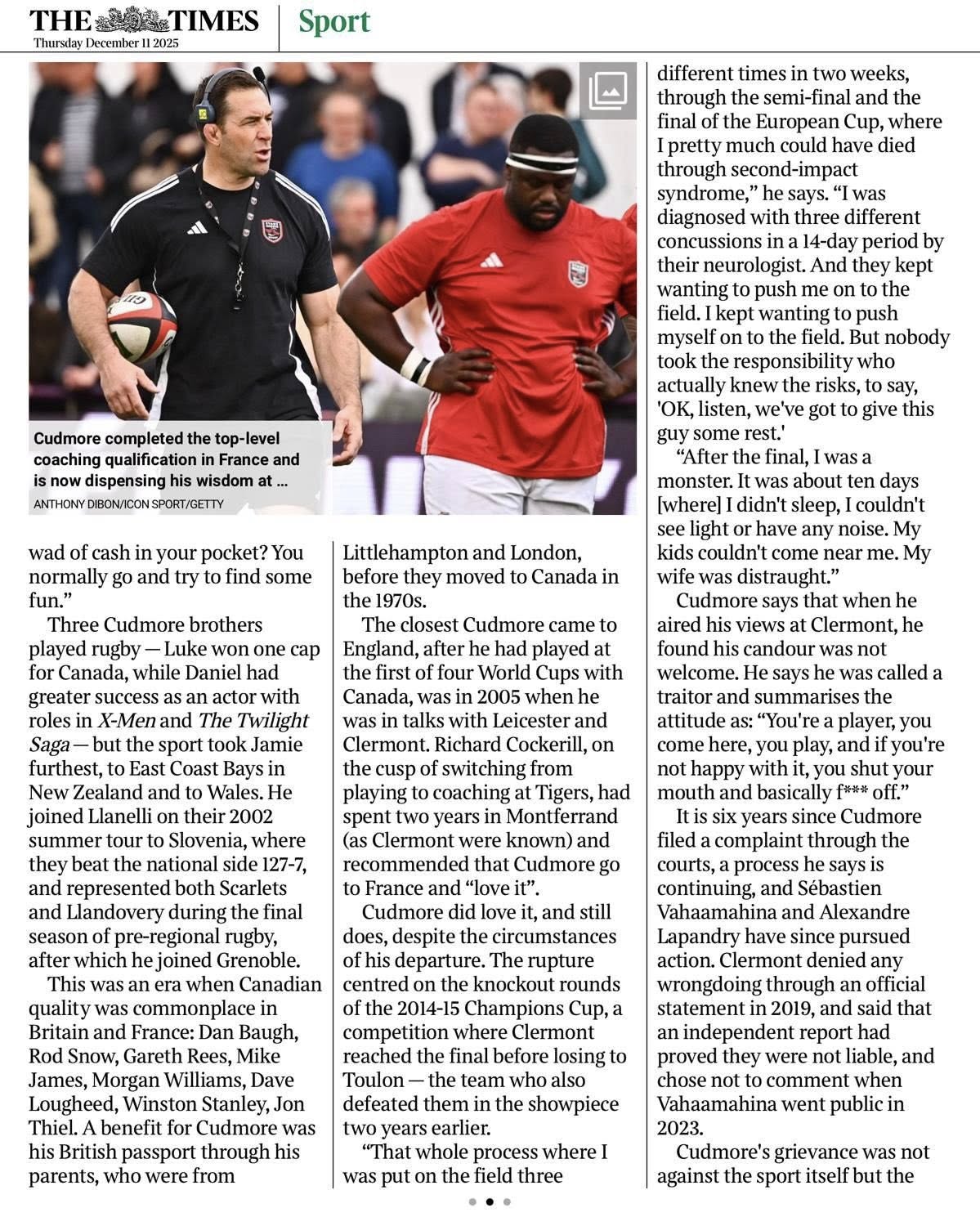
When Jamie Cudmore is not discharging his duties as assistant forwards coach at Nissa Rugby, the rebranded Riviera club in the hunt for promotion to Pro D2, you can find him in unexpected places. Norway (away) two months ago and Estonia (home) last Saturday, helping out James Kent with Luxembourg in the fourth tier of European competition.
Cudmore, 47, sold his French wine bar, Vinomania, when he started working with Rugby Canada’s development academy, thinking he would be home for good. Two years later he was sacked for social-media posts criticising the women’s sevens team at the Olympics. Cudmore apologised, citing his friendship with John Tait, who departed as head coach even though bullying allegations against him were deemed unfounded by Rugby Canada.
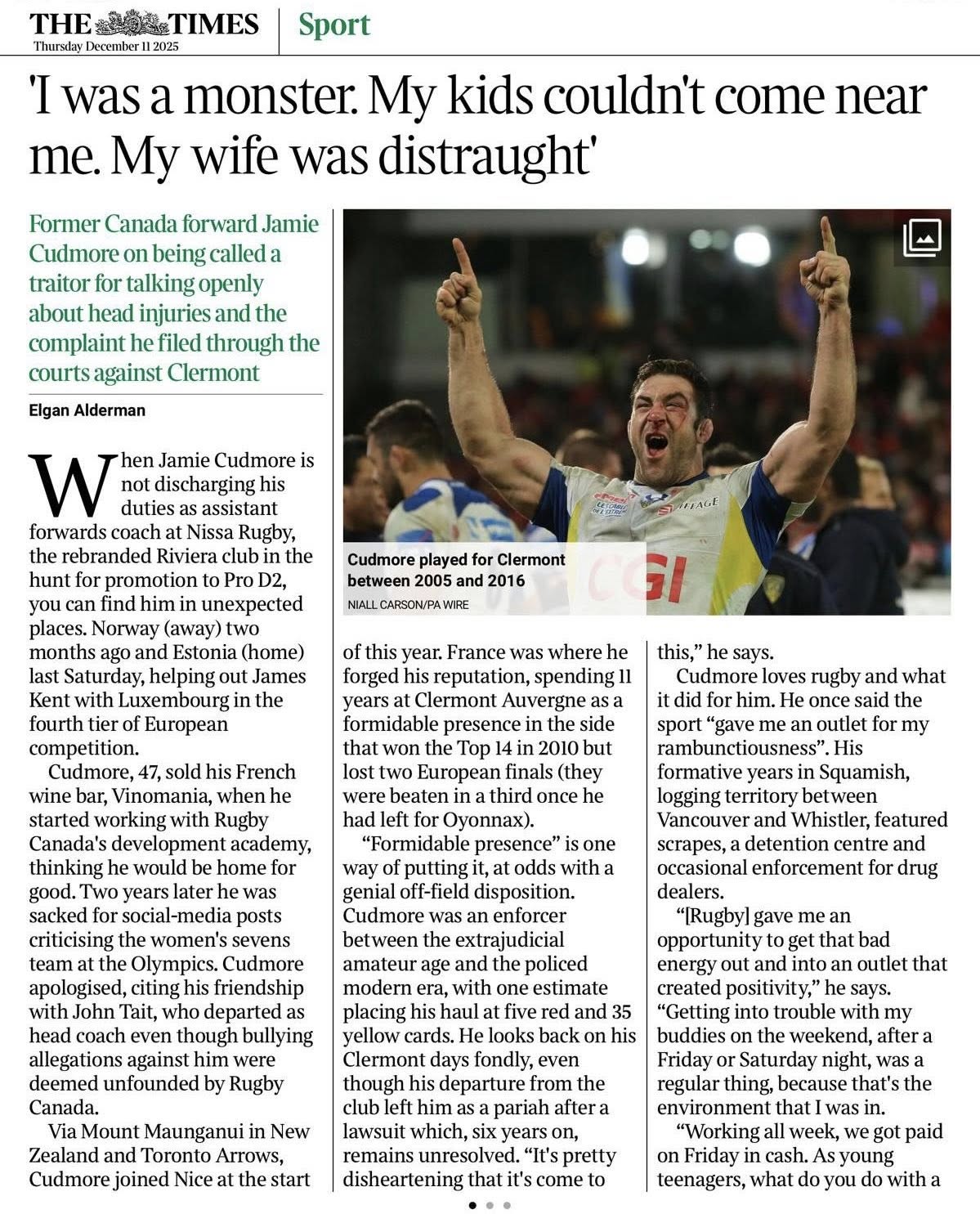
Via Mount Maunganui in New Zealand and Toronto Arrows, Cudmore joined Nice at the start of this year. France was where he forged his reputation, spending 11 years at Clermont Auvergne as a formidable presence in the side that won the Top 14 in 2010 but lost two European finals (they were beaten in a third once he had left for Oyonnax).
“Formidable presence” is one way of putting it, at odds with a genial off-field disposition. Cudmore was an enforcer between the extrajudicial amateur age and the policed modern era, with one estimate placing his haul at five red and 35 yellow cards. He looks back on his Clermont days fondly, even though his departure from the club left him as a pariah after a lawsuit which, six years on, remains unresolved. “It’s pretty disheartening that it’s come to this,” he says.
Cudmore loves rugby and what it did for him. He once said the sport “gave me an outlet for my rambunctiousness”. His formative years in Squamish, logging territory between Vancouver and Whistler, featured scrapes, a detention centre and occasional enforcement for drug dealers. “
[Rugby] gave me an opportunity to get that bad energy out and into an outlet that created positivity,” he says. “Getting into trouble with my buddies on the weekend, after a Friday or Saturday night, was a regular thing, because that’s the environment that I was in”.
“Working all week, we got paid on Friday in cash. As young teenagers, what do you do with a wad of cash in your pocket? You normally go and try to find some fun.”
Three Cudmore brothers played rugby — Luke won one cap for Canada, while Daniel had greater success as an actor with roles in X-Men and The Twilight Saga— but the sport took Jamie furthest, to East Coast Bays in New Zealand and to Wales. He joined Llanelli on their 2002 summer tour to Slovenia, where they beat the national side 127-7, and represented both Scarlets and Llandovery during the final season of pre-regional rugby, after which he joined Grenoble.
This was an era when Canadian quality was commonplace in Britain and France: Dan Baugh, Rod Snow, Gareth Rees, Mike James, Morgan Williams, Dave Lougheed, Winston Stanley, Jon Thiel. A benefit for Cudmore was Littlehampton and London, before they moved to Canada in the 1970s.
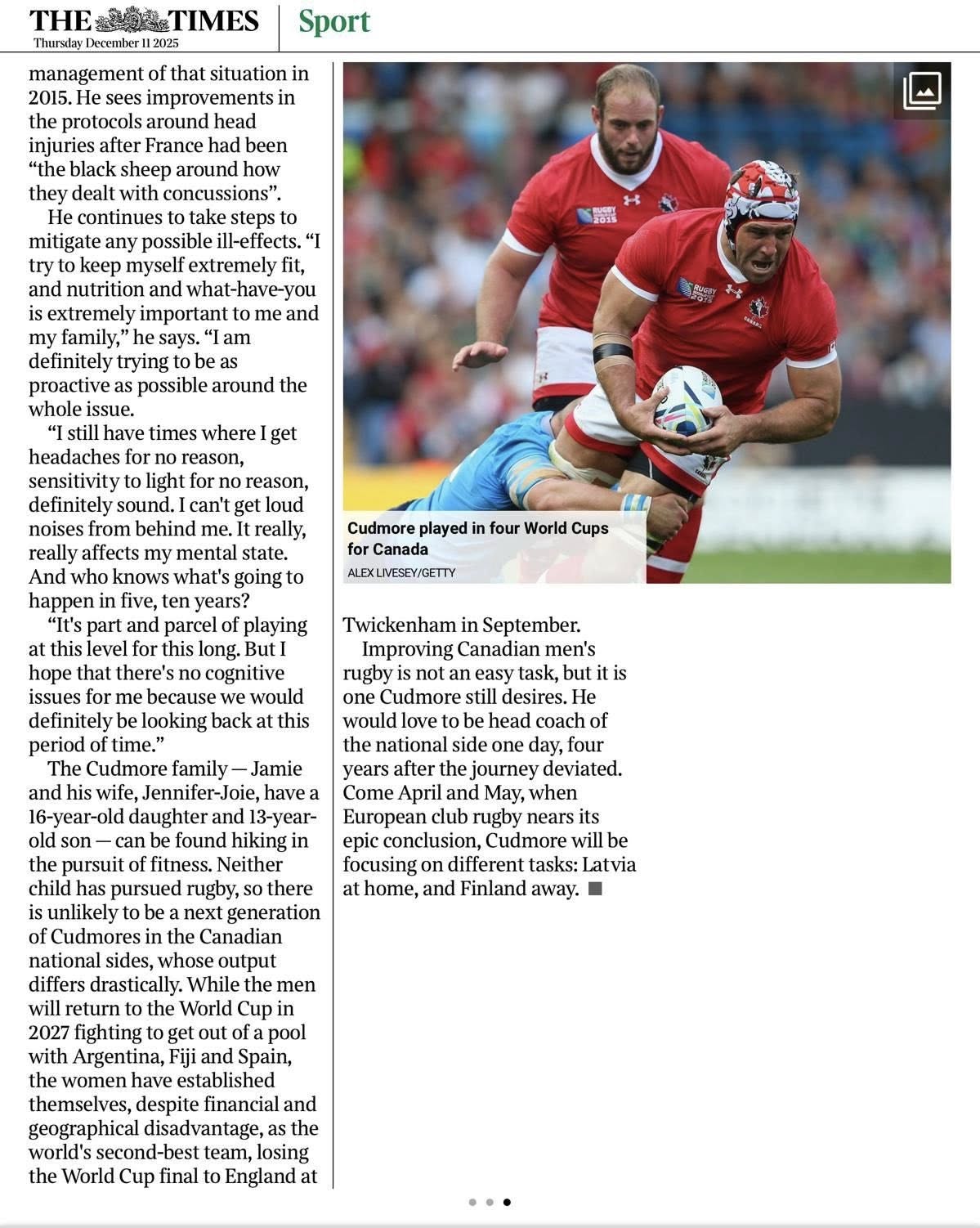
The closest Cudmore came to England, after he had played at the first of four World Cups with Canada, was in 2005 when he was in talks with Leicester and Clermont. Richard Cockerill, on the cusp of switching from playing to coaching at Tigers, had spent two years in Montferrand (as Clermont were known) and recommended that Cudmore go to France and “love it”.
Cudmore did love it, and still does, despite the circumstances of his departure. The rupture centred on the knockout rounds of the 2014-15 Champions Cup, a competition where Clermont reached the final before losing to Toulon — the team who also defeated them in the showpiece two years earlier.
“That whole process where I was put on the field three different times in two weeks, through the semi-final and the final of the European Cup, where I pretty much could have died through second-impact syndrome,” he says. “I was diagnosed with three different concussions in a 14-day period by their neurologist. And they kept wanting to push me on to the field. I kept wanting to push myself on to the field. But nobody took the responsibility who actually knew the risks, to say, ‘OK, listen, we’ve got to give this guy some rest.’”.
“After the final, I was a monster. It was about ten days [where] I didn’t sleep, I couldn’t see light or have any noise. My kids couldn’t come near me. My wife was distraught”.
Cudmore says that when he aired his views at Clermont, he found his candour was not welcome. He says he was called a traitor and summarises the attitude as: “You’re a player, you come here, you play, and if you’re not happy with it, you shut your mouth and basically f*** off”.
It is six years since Cudmore filed a complaint through the courts, a process he says is continuing, and Sébastien Vahaamahina and Alexandre Lapandry have since pursued action. Clermont denied any wrongdoing through an official statement in 2019, and said that an independent report had proved they were not liable, and chose not to comment when Vahaamahina went public in 2023.
Cudmore’s grievance was not against the sport itself but the management of that situation in 2015. He sees improvements in the protocols around head injuries after France had been “the black sheep around how they dealt with concussions”.
He continues to take steps to mitigate any possible ill-effects. “I try to keep myself extremely fit, and nutrition and what-have-you is extremely important to me and my family,” he says. “I am definitely trying to be as proactive as possible around the whole issue”.
“I still have times where I get headaches for no reason, sensitivity to light for no reason, definitely sound. I can’t get loud noises from behind me. It really, really affects my mental state. And who knows what’s going to happen in five, ten years?”.
“It’s part and parcel of playing at this level for this long. But I hope that there’s no cognitive issues for me because we would definitely be looking back at this period of time”.
The Cudmore family — Jamie and his wife, Jennifer-Joie, have a 16-year-old daughter and 13-year-old son — can be found hiking in the pursuit of fitness. Neither child has pursued rugby, so there is unlikely to be a next generation of Cudmores in the Canadian national sides, whose output differs drastically. While the men will return to the World Cup in 2027 fighting to get out of a pool with Argentina, Fiji and Spain, the women have established themselves, despite financial and geographical disadvantage, as the world’s second-best team, losing Twickenham in September.
Improving Canadian men’s rugby is not an easy task, but it is one Cudmore still desires. He would love to be head coach of the national side one day, four years after the journey deviated. Come April and May, when European club rugby nears its epic conclusion, Cudmore will be focusing on different tasks: Latvia at home, and Finland away.
Recommend Jamie’s book (written in French and translated) “In the Sin Bin”. Available on Amazon either as book or Kindle.
It’ll correct a few of the minor mistakes in the Times article.