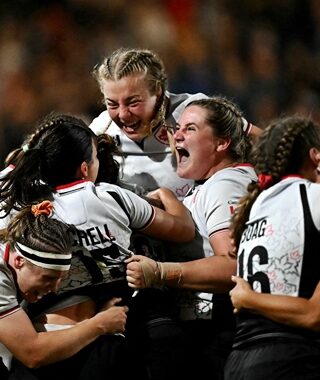
Canada Shock the Rugby World with Dominating Performance Over NZ 34-19
Canadian rugby fans knew that Canada could defeat NZ, they’ve done it before but no one thought they would dominate from the opening whistle, building up a 24-7 lead at the half, and then 31-7 early in the second half. NZ scored two second half tries at the 56′ and 65′ marks to put fans on the edge of their seat but Sophie de Goede put the worries to rest with a penalty kick at 74′ to make it a 3 score lead with 6 minutes left, 34-19.
The backs stepped up their game, it was always known the Canadian forwards would match up but the first 3 tries were scored by backs and 4 of the 5 tries in total with Sophie de Goede scoring the lone try by a forward. Not the usual match profile for Canada but one they needed to handle the Black Ferns.
There was dismay in NZ but elation in Canada with the likes of Shania Twain and Adam van Koeverden (Minister for Sport) sharing their support on social media. The video highlights are posted below as well as World Rugby’s RugbyPass article comparing the match performances by position.
Canada now face the winner of England v France which takes place tomorrow.
Tries: Justine Pelletier (8′), Asia Hogan-Rochester (11′), Florence Symonds (24′), Sophie de Goede (35′), Alex Tessier (43′)
Conversions: Sophie de Goede (36′, 44′, 8′)
Penalties: Sophie de Goede (74′)
https://www.youtube.com/watch?v=9kFoI3sEA0I
Oh you know it did https://t.co/Ub0vSX1zow
— Shania Twain (@ShaniaTwain) September 19, 2025
Canada defeats New Zealand in the Women’s Rugby World Cup semi-final. A truly incredible performance from our Canadian women—next stop, the finals!
Let’s Go @RugbyCanada pic.twitter.com/78ktlYfQFj— Adam van Koeverden (@vankayak) September 19, 2025
Player comparisons: Canada dismantle Black Ferns at Ashton Gate
By Philip Bendon
Canada secured their place in the 2025 Rugby World Cup final with a statement 34–19 dismantling of New Zealand’s Black Ferns at Ashton Gate in Bristol.
From the opening whistle, Canada set the tone. Within seven minutes, they cracked the Black Ferns’ defence around the breakdown, with relentless forward carries creating space for scrumhalf Justine Pelletier to score the opener.
That moment proved emblematic of the night. At the breakdown, Canada swarmed New Zealand with one-off carriers and sharp interplay. This constant pressure narrowed the Kiwi defensive line, leaving mismatches in the wide channels. Four tries in the first half told the story, as Canada stormed to a commanding 24–7 lead at the break.
The second half began as the first had: with a Canadian strike. Captain Alex Tessier finished off another bruising sequence from her pack to push the lead further. At 29–7, the deficit looked insurmountable.
To their credit, the Black Ferns responded. Playing with a freedom absent in the opening 50 minutes, their attack finally clicked. Two quick tries brought hope of a comeback. But Canada steadied, reverting to the formula that had carried them: kicking for territory, swarming the breakdown, and forcing penalties. A crucial three-pointer in the 73rd minute effectively ended the contest.
The Black Ferns never stopped attacking, but Canada’s composure and defensive organisation meant the defending champions bowed out short of the final.
Here’s how the head-to-head battles played out across the park.
Front Row – Advantage New Zealand
If there was one area the Black Ferns could claim as theirs, it was up front. The trio of Chryss Viliko, Georgia Ponsonby and Tanya Kalounivale carried hard, scrummaged well, and gave their side a foothold.
At set piece, they pressured Canada on their own feed and disrupted clean launches. With ball in hand, they were among New Zealand’s most effective weapons. Ponsonby in particular impressed, her 26th-minute break setting up Kalounivale for New Zealand’s first try.
Statistically, Ponsonby was immense: nine carries for 38 metres, plus a team-high 21 tackles, including two dominant hits. Kalounivale and Viliko combined for 26 tackles of their own, underlining the front row’s effort in a losing cause.
Second Row – Advantage Canada
Here was the defining difference. Sophie de Goede and Courtney O’Donnell produced all-time performances.
De Goede’s stat line was absurd: 17 carries for 74 metres, two line breaks, three defenders beaten, 21 tackles, 10 lineouts secured, and a try. Her dominance at both set piece and open play was the heartbeat of Canada’s win. At just 26, she’s now firmly in the frame for World Player of the Year.
O’Donnell complemented her perfectly, locking down New Zealand’s lineout and providing relentless defensive work. Together, they tilted the contest in Canada’s favour and never let it swing back.
Back Row – Draw
Two outstanding back rows went punch-for-punch all evening in front of over 24,000 fans at Ashton Gate.
For New Zealand, number eight Kaipo Olsen-Baker was colossal. She carried 34 times for 150 metres, beat 10 defenders, made two line breaks, and added 14 tackles. She was the Black Ferns’ standout performer, single-handedly dragging them into contention. Flankers Liana Mikaele-Tu’u and Kennedy Tufuafu added 29 tackles combined, with Tu’u scoring the try that briefly reignited belief.
But Canada’s trio matched them blow for blow. Caroline Crossley, Karen Paquin and Fabiola Forteza combined for an extraordinary 59 tackles and 10 turnovers. Their ferocity at the breakdown denied New Zealand any rhythm and starved their playmakers of clean ball. While not as eye-catching with ball in hand, their defensive steel was the platform for everything Canada achieved.
Halfbacks – Advantage Canada
Few areas were as decisive as the battle at nine and ten, where Justine Pelletier and Taylor Perry controlled the game with authority.
Their kicking game consistently found grass behind the Black Ferns, forcing their back three to scramble in a way unseen at any stage throughout the World Cup. From the base of the ruck, Pelletier’s box-kicks were contestable and accurate, allowing her back three to harass the Black Ferns in the air.
In open pla,y Perry’s distribution gave Canada the width to stretch New Zealand’s defence. This ability to get to the fringes rapidly saw the Canadians chew up meters in a flash.
Individual Pelletier was electric with ball in hand. Sniping around the ruck, linked support runners, and offloaded brilliantly. Perry’s calmness under pressure ensured Canada’s attack flowed, particularly when targeting New Zealand’s defensive linchpin Stacey Waaka.
Centres – Advantage Canada
Physically and tactically, Tessier and Florence Symonds shut down New Zealand’s midfield.
They targeted Ruahei Demant relentlessly, forcing her deep and limiting her ability to generate front-foot ball for those around her. Their defensive line never disconnected, and Symonds’ timing in the tackle stifled momentum whenever New Zealand threatened to go wide.
Offensively, both centres made their mark with a try apiece. Tessier’s tactical kicking also played a key role in keeping Canada in prime attacking positions, with touch-finders regularly pinning the Black Ferns back inside their own 22.
Back Three – Advantage Canada
Comprehensively shutting down the Black Ferns’ normally exceptional kicking game, the Canadian back three had themselves a day.
Returning kicks with aplomb, both with the boot and in hand, the North Americans exposed the fractured backfield of their rivals.
At the heart of the counterattacks was Julia Schell, who continually targeted Portia Woodman-Wickliffe’s wing with up-and-unders, sniping runs and clever short chip kicks.
Off strike plays, Asia Hogan-Rochester and Alysha Corrigan continually found spaces on the edge. Utilising their pace to find soft shoulders, the pair physically outflanked their opposite numbers.
Defensively, the birds-eye view from Ashton Gate’s press tribune saw a well-oiled machine. Constantly communicating, the Canadian backfield covered every blade of grass, suffocating the life out of New Zealand’s kicking game.
No Changes to Canada Roster to Take on NZ on Friday in World Cup Semi-Final
There are no changes to the Canada roster that defeated Australia in the quarter-finals. Word out of the Black Ferns camp is that their starting openside flanker, Jorja Miller, didn’t recover from an injury picked up in their quarter-final against South Africa, and won’t be in the roster against Canada.
It was always going to come down to this game for Canada with the pool rounds and the quarter-final just a formality. Even though Canada are ranked #2 and NZ #3, betting sites still have NZ as slight favourites. The BC Lottery PlayNow site has NZ at 1.73 and Canada at 2.20. The other semi-final is heavily in favour of England, with PlayNow showing England at 1.04 and France at 11. Overall England are heavy favourites to win it all with odds at 1.25, NZ 7.00, Canada 8.00 and France 26.00.
Canada’s record against NZ since 1991 is 1-17-1 but Canada’s record since 2024 is 1 win and 1 draw. It likely will be a close game with only 3 points between the teams over the last two matches.
Kick off is Friday, September 19, at 11:00 a.m. PT and is shown on TSN.
Canada Roster
1. McKinley Hunt (King City, ON) – Aurora Barbarians / Saracens (36 caps)
2. Emily Tuttosi (Souris, MB) – Calgary Hornets / Exeter Chiefs (39 caps)
3. DaLeaka Menin (Vulcan, AB) – Calgary Hornets / Exeter Chiefs (67 caps)
4. Sophie de Goede (Victoria, BC) – Castaway Wanderers / Saracens (39 caps)
5. Courtney O’Donnell (Rimbey, AB) – Red Deer Titans Rugby (51 caps)
6. Caroline Crossley (Victoria, BC) – Castaway Wanderers (11 caps)
7. Karen Paquin (Quebec City, QC) – Club de rugby de Quebec (49 caps)
8. Fabiola Forteza (Quebec City, QC) – Club de rugby de Québec / Stade Bordelais (39 caps)
9. Justine Pelletier (Rivière-du-Loup, QC) – Club de rugby de Québec / Stade Bordelais (41 caps)
10. Taylor Perry (Oakville, ON) – Oakville Crusaders / Exeter Chiefs (21 caps)
11. Asia Hogan-Rochester (Toronto, ON) – Toronto Nomads / Westshore RFC (6 caps)
12. Alexandra Tessier (Sainte-Clotilde-de-Horton, QC) – Sainte-Anne-de-Bellevue RFC / Exeter Chiefs (64 caps)
13. Florence Symonds (Vancouver, BC) – University of British Columbia (16 caps)
14. Alysha Corrigan (Charlottetown, PEI) – CRFC / Saracens (24 caps)
15. Julia Schell (Uxbridge, ON) – Guelph Goats / Castaway Wanderers / Ealing Trailfinders (30 caps)
16. Gillian Boag (Calgary, AB) – Capilano RFC (37 caps)
17. Brittany Kassil (Guelph, ON) – Guelph Goats (51 caps)
18. Olivia DeMerchant (Mapledale, NB) – Halifax Tars RFC (64 caps)
19. Tyson Beukeboom (Uxbridge, ON) – Cowichan Piggies / Aurora Barbarians / Ealing Trailfinders (82 caps)
20. Laetitia Royer (Loretteville, QC) – St-Anne-de-Bellevue / Concordia University / Saracens (20 caps)
21. Gabrielle Senft (Regina, SK) – Castaway Wanderers / Saracens (38 caps)
22. Olivia Apps (Lindsay, ON) – Lindsay RFC (23 caps)
23. Shoshanah Seumanutafa (White Rock, BC) – Counties Manukau (23 caps)
from Rugby Canada
With a place in the Rugby World Cup final on the line, Head Coach of Canada’s Women’s Rugby Team, Kevin Rouet, has announced Canada’s match day roster for their semi-final clash against the New Zealand Black Ferns. The game will take place on Friday, September 19, at 11:00 a.m. PT / 2:00 p.m. ET (7:00 p.m. local time in England) at Ashton Gate Stadium in Bristol.
In their last two encounters, Canada has defeated and drawn with the Black Ferns who are the defending Rugby World Cup champions. In 2024, Canada earned a historic 22–19 victory over New Zealand to win the Pacific Four Series. Earlier this year in Christchurch, the Black Ferns scored a last-minute try to draw level with Canada, ranked second in the world, at 27-27. Despite a late go-ahead try from Shoshanah Seumanutafa in the 76th minute, a missed conversion by New Zealand attack saw the match end in a draw.
“We have shown over the past two years that we are one of the best teams in the world, and our last two results against New Zealand support that,” said Rouet. “We have every reason to believe that we can win this game. On Friday, we take another step toward the ultimate goal we have been building toward over our first four games and the last three years. It will be a short week of preparation, but the team will be ready.”
Canada’s lineup remains unchanged from the 23-player roster that delivered a 46–5 quarter-final victory over Australia last weekend.
As a team, Canada has outscored their opponents 193-31 in four games at the Rugby World Cup. They lead the tournament in carries with 622 and sit second overall in offloads with 66 on their way to scoring 30 tries so far.
Defensively, Karen Paquin—set to earn her 50th cap for Canada this weekend—leads the team with 57 tackles. DaLeaka Menin, currently third on the team in tackles with 41, will earn her 68th cap, moving her into second place on Canada’s all-time cap list for women.
On attack, Canada will once again be led by Sophie de Goede, Julia Schell, Asia Hogan-Rochester and Alysha Corrigan.
Schell, who made headlines with six tries in Canada’s opening match—setting a record for the fastest hat-trick in Rugby World Cup history—is tied for the team lead in meters carried (287). Hogan-Rochester, with two tries in three games, shares that honor and Corrigan has recorded four tries so far in the competition and has carried for 198 meters. De Goede is currently third overall in tournament scoring with 44 points (two tries and 17 conversions).
WHERE TO WATCH
Canada’s Rugby World Cup semi-final match against New Zealand on September 19 will kick off at 11:00am PST / 2:00pm EST (7:00pm local time in England) and will be available on TSN. All of Canada’s games at the Rugby World Cup will be broadcast live, along with bonus coverage of select non-Canada matches throughout the tournament. The broadcast schedule is available here.