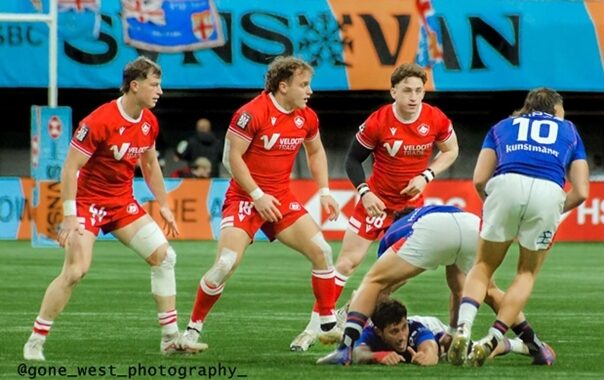
Canada Win Challenge Series with 3-1 Record: Next Montevideo on March 21-22
After winning both matches on Day 1 against Chile and Japan, Canada went 1-1 on Day 2, losing to Chile and defeating Japan. That gives them an overall 3-1 record and the Challenge tournament title. It’s scant consolation if they can’t convert that momentum to a better performance in the two remaining SVNS 2 tournaments in Montevideo (March 21-22) and Sao Paulo (March 28-29) to claim a top 4 position. It will be interesting to see who head coach Christiaan Esterhuizen chooses for the tour. Lockie Kratz, the team leader, looks a lock and Morgan di Nardo is starting to reclaim his form. Jack Shaw showed well in the last match, Ian Jones showed some pace and tracked back well on defence. Young players like Adam Doane and Andrew Cooper would be an asset. Veterans Elias Hancock and Johnny Franklin might be on the list. Will Thomas Isherwood and Josiah Morra be healthy for the trip? That announcement might show up next week from Rugby Canada.
from Rugby Canada
Canada Men 10 Chile 12
Canada fell to Chile 12–10 in a tight match, their first loss of the weekend. Johnny Franklin opened the scoring after collecting a loose ball on Chile’s 5-metre line and powering over to give Canada a 5–0 lead.
Chile responded before halftime with a converted try to take a 7–5 advantage into the break. In the second half, Ian Jones ran up the sideline to restore Canada’s lead at 10–7. However, Chile answered late when an attacker split two Canadian defenders in the 15-metre channel to score the decisive try, securing the 12–10 victory.
Scoring Summary: Johnny Franklin (1T), Ian Jones (1T)
Canada Men 31 Japan 7
Japan opened the scoring, but Canada responded immediately with back-to-back tries from captain Lockie Kratz and Jack Shaw to take control of the game.
Kratz and Shaw later combined for a highlight-reel try, as Kratz delivered a behind-the-back offload to Shaw, extending Canada’s lead to 19–7. Shaw crossed for his third try of the match early in the second half, pushing the advantage to 26–7.
Morgan Di Nardo added a late try to seal the win, and Canada claimed the Teck Tri-Nations Challenge title with a convincing 31–7 victory
Scoring Summary: Jack Shaw (3T), Lockie Kratz (1T, 3C), Morgan Di Nardo (1T)
A WORD FROM THE COACH
“It’s always nice to win, it’s always the mindset coming into a competition to prove yourself, go through these high pressure matches and still come out on top,” said Christiaan Esterhuizen, Head Coach of Canada’s Men’s Sevens Team. “We felt disappointed this morning after that loss to Chile, it was a tough one for us but the takeaway for me is the bounce back against Japan. I am really happy we gave the home crowd an exciting finish.”
UP NEXT FOR CANADA
Canada’s men will travel to South America for the final two events of the HSBC SVNS 2 starting in Montevideo, Uruguay on March 21-22 followed by Sao Paulo, Brazil on March 28-29. Both tournaments will be available to watch on TSN+.
TECK TRI-NATIONS CHALLENGE
This competition will serve as key preparation for the Canadian men ahead of the final two HSBC SVNS 2 Series events later in March, supporting their push to return to the top tier of the global series. Teck, a leading Canadian resource company, is expanding its partnership with Rugby Canada by supporting the men’s invitational tournament. More information can be found here.
CANADA’S MEN’S SEVENS TEAM VANCOUVER ROSTER
3. Ethan Turner (Maple Ridge, BC) – Burnaby Lake Rugby Club
7. Johnny Franklin (Bowen Island, BC) – Capilano RFC
10. Adam Doane (Sutton, ON) – Aurora Barbarians
13. Brenden Black (Oakville, ON) – Oakville Crusaders
14. D’Shawn Bowen (Toronto, ON) – James Bay AA / Agronomia Rugby
17. Jesse Kilgour (Oro-Medonte, ON) – Pacific Pride / Barrie RFC
18. Morgan Di Nardo (Toronto, ON) – Toronto Scottish / University of Victoria
22. Kyle Tremblay (White Rock, BC) – Bayside RFC
24. Thomas Cuzange (Toulon, France) – Pacific Pride
28. Henry Kirwan (Brighton, ENG) – Brighton Blues / Cardiff Metropolitan University
37. Ian Jones (Bass River, NS) – Ajax Wanderers / Pictou County
44. Lockie Kratz (Victoria, BC) – Castaway Wanderers / UBCOB Ravens
55. Jack Shaw (Oakville, ON) – Castaway Wanderers / Oakville Crusaders
64. Elias Hancock (Ottawa, ON) – University of Ottawa / Bytown Blues
66. Andy Cooper (Vancouver, BC) – Meralomas RFC
98. Brock Gallagher (Edmonton, AB) – Strathcona Druids RFC
Canada Men 2-0 on Day One of Vancouver Tournament
Today it was the men’s team who brought joy to the crowd as they won both of their matches in their Challenge tournament against Japan and Chile. Hopefully the momentum will carry through to Day 2 and then the SVNS 2 tournaments in South America later this month. A highlight was the first try by Andrew Cooper on his debut, he looks a promising prospect with size and a good work ethic. He’s from Kitsilano High School adjacent to the Meraloma club where he played rugby, he also spent some time with SAS Rugby Academy in South Africa.
from Rugby Canada
Canada Men 28 Japan 26
Trailing multiple times throughout the game, the Canadian men kept their composure and took the lead for the first time late in the match. A try from Capilano RFC’s Johnny Franklin, followed by Ethan Turner’s conversion, put Canada up 28–26 with less than a minute to play.
Canada forced a Japan penalty with only seconds remaining on the clock to regain possession and secure the victory — their first of the weekend on home soil, backed by a vibrant crowd inside BC Place Stadium.
Andy Cooper and Kyle Tremblay each chipped in with a try earlier in the second half when Canada found themselves trailing 24–14. Ian Jones scored Canada’s first try of the weekend.
Scoring Summary: Johnny Franklin (1T), Kyle Tremblay (1T), Andy Cooper (1T), Ian Jones (1T), Lockie Kratz (2C), Ethan Turner (2C)
Canada Men 7 Chile 0
Canada secured a hard-fought 7-0 victory over Chile, with Kyle Tremblay scoring the match’s only try. Both teams battled in a tightly contested defensive game, but Canada held strong through multiple attacking phases late in the match. Key midfield tackles helped force a crucial knock-on from Chile, allowing Canada to regain possession, secure a scrum, and eventually kick the ball out to seal their second win of the day. The result moved Canada to 2-0 on the day.
Scoring Summary: Kyle Tremblay (1T), Lockie Kratz (1C)
A WORD FROM THE COACH
Christiaan Esterhuizen, Head Coach of Canada’s Men’s Sevens Team spoke after his squad defeated Japan and Chile in their two games on Saturday in Vancouver: “It was a gutsy effort today, two-point game against Japan needing to comeback from a big deficit at halftime and then a scrappy one against Chile. Some tight matches but character from all the guys to perform in front of the home crowd was evident.”
“The effort they put in to keep Chile out phase after phase, that crowd definitely helps the guys work just that extra bit harder. They know they are out there playing for their friends, families and representing the country of Canada.”
UP NEXT FOR CANADA
Canada Men vs Chile | 2:01pm PT / 5:01pm ET | TSN1, TSN5, & TSN+
Canada Men vs Japan | 5:04pm PT / 8:04pm ET | TSN4 & TSN+
Head Coach Christiaan Esterhuizen Names 16 Players for Canada’s Teck Tri-Nations Challenge Team at Vancouver 7s
Head Coach Christiaan Esterhuizen has named 16 players to participate in the three team tournament taking place during the Vancouver 7s. The women are playing in the main tournament, the men fell out of the Tier 1 tournament so Rugby Canada organized a three team tournament to keep the men’s side included in the overall event. It comes at a good time for the men as they need to up their game having finished last in the previous Tier 3 tournament in Nairobi. They have two more Tier 3 tournaments left this month and they need to finish top four overall to advance to the Tier 2 tournaments in April.
They have named 16 players to get a good look at all possibilities. With #1 scrum half Thomas Isherwood out with injury they have brought in two possible replacements Jesse Kilgour and Brock Gallagher. Josiah Morra returns to the squad after missing Nairobi. Canada will play Japan and Chile on both Saturday and Sunday, schedule times listed below.
Canada Roster
3. Ethan Turner (Maple Ridge, BC) – Burnaby Lake Rugby Club
6. Josiah Morra (Toronto, ON) – Balmy Beach RFC
7. Johnny Franklin (Bowen Island, BC) – Capilano RFC
10. Adam Doane (Sutton, ON) – Aurora Barbarians
13. Brenden Black (Oakville, ON) – Oakville Crusaders
14. D’Shawn Bowen (Toronto, ON) – James Bay AA / Agronomia Rugby
17. Jesse Kilgour (Oro-Medonte, ON) – Pacific Pride / Barrie RFC
18. Morgan Di Nardo (Toronto, ON) – Toronto Scottish / University of Victoria
22. Kyle Tremblay (White Rock, BC) – Bayside RFC
28. Henry Kirwan (Brighton, ENG) – Brighton Blues / Cardiff Metropolitan University
37. Ian Jones (Bass River, NS) – Ajax Wanderers / Pictou County
44. Lockie Kratz (Victoria, BC ) – Castaway Wanderers / UBCOB Ravens
55. Jack Shaw (Oakville, ON) – Castaway Wanderers / Oakville Crusaders
64. Elias Hancock (Ottawa, ON) – University of Ottawa / Bytown Blues
66. Andy Cooper (Vancouver, BC) – Meralomas RFC
98. Brock Gallagher (Edmonton, AB) – Strathcona Druids RFC
Non-Traveling Reserves
Thomas Cuzagne (Toulon, France) – Pacific Pride
Reece Thompson (Minesing, ON) – University of Victoria / Barrie Rugby Club
Glenn Roy (Ottawa, ON) – Ottawa Irish
Unavailable / Injured
Demetri Patterson (West Vancouver, BC) – University of British Columbia
Ethan Fryer (Seattle, USA)
Kal Sager (Peterborough, ON) – Peterborough Pagans
Takoda McMullin (White Rock, BC) – University of British Columbia
Thomas Isherwood (Okotoks, AB) – Foothills Lions RFC / Westshore RFC
Men’s Schedule
Saturday March 7
Canada’s Men’s Sevens Team vs Japan
2:23pm PT / 5:23pm ET
Watch on TSN2 & TSN+
Canada’s Men’s Sevens Team vs Chile
6:12pm PT / 9:12pm ET
Watch on TSN2 & TSN+
Sunday March 8
Canada’s Men’s Sevens Team vs Chile
2:01pm PT / 5:01pm ET
Watch on TSN1, TSN5, & TSN+
Canada’s Men’s Sevens Team vs Japan
5:04pm PT / 8:04pm ET
Watch on TSN4 & TSN+
from Rugby Canada
Sixteen players have been named to Canada’s Men’s Sevens Team ahead of the Teck Tri-Nations Challenge taking place alongside the 11th edition of HSBC SVNS Vancouver.
Captained by Victoria’s Lockie Kratz, Canada’s Men’s Sevens Team will play Japan and Chile in a double round robin at BC Place over March 7 and 8 ahead of participating in the second stop of HSBC SVNS 2, the next step in their journey towards promotion to the first tier of the HSBC SVNS Series.
“Vancouver is an important moment for this group. It’s an opportunity to demonstrate our growth and to represent the wider Canadian rugby system with pride… we’re determined to put on a performance that excites and inspires.” Said Head Coach Christiaan Esterhuizen.
Passes to HSBC SVNS Vancouver will give fans access to the Teck Tri-Nations Challenge. Tickets are available at vansevens.com.
Among the 16 players named to the roster, Josiah Morra is set to officially return to sevens for the first time since his appearance at the 2024 RAN Sevens. Edmonton-born scrum-half Brock Gallagher, who has earned 12 caps with Canada’s Men’s Rugby Team, is poised to make his sevens debut. Vancouver native Andy Cooper is also in line for his first appearance in the sevens format.
“We’re not chasing a moment in Vancouver – we’re building consistency. This weekend is about raising our standards in the details… if we get that right, it sets the tone for how we perform over the next two stops in South America. We want to leave Vancouver sharper and more connected than when we arrived.”
Jesse Kilgour, who made his international sevens debut in Hong Kong in 2024 and earned his first cap with Canada’s Men’s Rugby Team later that year in Bucharest, returns to competition following rehabilitation from a shoulder injury. Jesse will join his sister Eden in Vancouver who has been named to Canada’s Women’s Sevens Team.
Six members of the squad — Tremblay, Morra, Di Nardo, Black, Shaw, and Gallagher — recently represented Canada’s Men’s Rugby Team during their 2027 Rugby World Cup qualification campaign and autumn test matches, bringing valuable international experience to the lineup and leaning on Rugby Canada’s One Squad philosophy which allows players to transition between the 15s and 7s game.
In Vancouver, Head Coach of Canada’s Men’s Rugby Team Stephen Meehan joins Head Coach Christiaan Esterhuizen as assistant coach for the weekend. Together, they will lead the squad while further strengthening the cohesion and connectivity across programs — a collaborative approach that continues to drive Canadian rugby forward.
“Stephen’s involvement is part of our One Squad philosophy. When our programs align, we accelerate growth. That connection strengthens both environments and raises expectations across the system. It’s great having someone with Stephen’s experience around – his perspective adds real value to the group.”
Due to injury, Thomas Isherwood and Demetri Patterson were not available for selection. Kal Sager was not available for selection due to university commitments.
THE ROAD TO TIER 1 OF THE HSBC SVNS SERIES
Canada’s Men’s Sevens Team claimed gold at the Rugby Americas North Sevens Tournament in November, earning qualification to the HSBC SVNS 3 Challenger.
In January, the team continued its strong performance by winning gold at the HSBC SVNS 3 Challenger in Dubai to secure a place in HSBC SVNS 2. SVNS 2 is a three-event series featuring Canada, Kenya, USA, Germany, Uruguay, and Belgium.
Canada opened the series with a sixth-place finish in Nairobi and will next compete in Montevideo (March 21–22) and São Paulo (March 28–29).
The top four teams at the conclusion of the HSBC SVNS 2 series will advance to join the eight core teams on the HSBC SVNS Series for the three-event SVNS World Championship. The Championship begins in Hong Kong (April 17–19), followed by Valladolid (May 29–31) and Bordeaux (June 5–7). The series will culminate with the crowning of the Men’s and Women’s World Champions, marking the finale of the newly formatted HSBC SVNS Series announced in 2025.
TICKETS
Tickets for HSBC SVNS Vancouver are available at vansevens.com. Questions regarding ticket purchases can be directed to tickets@vansevens.com. For more information on suites, please contact suites@vansevens.com. Please note that these inboxes will be monitored during regular office hours, Monday to Friday, 8:00am to 5:00pm PT.
I thought Lockie Kratz played for UVic and CW, I don’t think he ever played for the Old boys?
He played a few games this year for them
What about Josiah Morra didn’t he play a game for us as well, Old Boys. Can’t we claim him also? Please correct if comment is wrong.
I could only see him listed in one game, against UBC, what other games did he play in.
Other than Andy Cooper (Vancouver) – Meraloma Rugby Club- not other player from Vancouver, yet Saint George high school (Vancouver) consistently top Provincial rugby high school, what does this tell you?
Any feedback?
It doesn’t tell you anything. St George’s have won 2022-2024, majority of these players are 3-10 years older.
Low and Slow, I think my question may have been misunderstood. The beauty of AI
Below are the results:
BC Senior Boys Rugby Championship Highlights (Last 15 Years)
Year AAA / AAAA Champion Key Finalist / Notable Participant
2025 St. George’s School Shawnigan Lake School
2024 St. George’s School Shawnigan Lake School
2023 St. George’s School Shawnigan Lake School
2019 Shawnigan Lake School Earl Marriott Secondary
2018 Oak Bay High School Shawnigan Lake School
2017 Shawnigan Lake School St. George’s School
2016 Shawnigan Lake School Yale Secondary
2015 Shawnigan Lake School St. Michaels University School
2014 St. George’s School Shawnigan Lake School
2013 Shawnigan Lake School St. George’s School
2012 Shawnigan Lake School St. George’s School
2011 Shawnigan Lake School St. George’s School
2010 Shawnigan Lake School St. George’s School
St George has been consistent in sending top teams and player to the high school Provincial championship. My question is, with such a talent pool, how many players and percentage of grads go on to play and represent Canada. If the numbers are low then why? I do understand many go on to play at university and U20 level but stop after why? This question could apply to all private schools. If there is an issue identified then maybe Canada Rugby should maybe spending their time and resources looking eles where for future Canada talent. Just my opinion.
Only 3 over 20 years
Becasue I was curoius: I asked AI (please note AI response may have flaws but worth reviewing)
Question asked of AI to research:
How many of the boys that went to Saint Goerge High School in Vanocuver, BC and played in their Rugby program ended up playing and representing Canada under Rugby Canada’s 7s and 15s program over the last 20 years?
Copilot said:
Copilot
Short answer
At least 3 former St. George’s School (Vancouver) rugby players have gone on to represent Canada at the senior international level (Rugby Canada 7s and/or 15s) over the past 20 years (≈2006–2026), based on verifiable public records and school‑published confirmations.
How this number is determined (and why it’s conservative)
Because Rugby Canada does not publish centralized “feeder‑school” statistics, the only reliable way to answer this is by triangulating:
Official St. George’s School rugby program statements
Individual player biographies and international caps
Rugby Canada / Olympic documentation
Using that method, we can confirm three unique individuals with certainty.
Confirmed St. George’s alumni who represented Canada
✅ Conor Trainor (Class of 2007)
School: St. George’s School, Vancouver
Canada 15s:
Senior men’s national team
2011 Rugby World Cup
Canada 7s:
Pan American Games
Tokyo 2020 Olympic Games
Trainor’s biography explicitly states he started playing rugby at St. George’s School and later represented Canada in both 7s and 15s.
wikipedia
✅ Two additional St. George’s alumni – Canada Men’s Olympic 7s (Tokyo 2020)
St. George’s School officially states:
*“Recently, *three St. George’s alumni appeared for the first ever Canadian Olympic Men’s Rugby Sevens team at Tokyo 2020.”
Since Conor Trainor is one of the three, this confirms two additional St. George’s graduates who:
Played in the Rugby Canada Men’s Sevens program
Represented Canada at the Olympic level (2020)
While the school does not name them publicly on the program page, the statement itself is authoritative and verifiable.
bc
Final confirmed count (last 20 years)
Category Number
Unique St. George’s alumni who represented Canada (7s and/or 15s) 3
Canada 7s representatives 3
Canada 15s representatives At least 1 (Trainor)
✅ Answer: 3 players (minimum confirmed)
After reading the results, my interpretation is that most but not all the boys that come out of St George’s rugby program do not really have the incentive to play higher, therefore Rugby Canada should be identifying and spending money and resource developing players at the U16, U18, U19 level who may not be as talents at a young age but on players that have a strong desire, heart, motiviation, pride and commitament to continue to develop and play. I think this may just apply to all private shools in BC. Just my opinion
The other two are Theo Sauder and Phil Berna, both for Canada 7’s.
I think you’d have to balance the stats on one school in one province against other top schools across the country. Is 3 athletes a low number compared to other strong rugby high schools in Ontario, Alberta, and the Maritimes? I have no idea.
As to your other point around representation at university and U20 level – the number of athletes who convert from U20 to senior men’s is staggeringly low. If you look at the U20 roster year over year compared to who actually gets a cap at the senior level the number is below 15% (last time I did the math was in 2023 but I think that should still be somewhat accurate).
So I’d suggest it’s not the case of one school creating strong rugby players at the high school level and then fizzling out, it’s more so a case of not really developing players for anything beyond U20 / university. What are the opportunities to play at a high level now that MLR is effectively defunct?
That being said, age grade rugby is a pay to play model so it’s not surprising that the athletes with more family money end up getting more spots for BC and RC. That’s a problem that needs to be fixed with more sustainable funding models from the private sector.
Adam Doane plays for UVic Vikes.
Shane, thank you for updating. I think it is important to acknowledge the University and Clubs, and the youth program that players come from that were responsible for their early development. To credit the coaches, programs and clubs in players early Developement and not to “Name drop” clubs of players parachuted in or temp players. I think it would be important to the Canada Rugby program to know where exactly our players are coming from, just my opinion.
The numbers from Saints are low because many realize incredibly quickly that there is no money to be made in Rugby. There are a few that persevere despite it (Berna). But by the time Saints players, many of whom go play for UBC, finish their degree, and realize they can play rugby for $1300 a month, or use that new degree and make a considerable amount more. The answer is and always will be money unfortunately. I played with many good Saints players, Berna and Sauder included, and the majority of them live much more comfortable lives with good jobs than had they decided to stick with rugby for 10 years after graduation
The Hard Truth, thank you for your honesty and candid comments. I think your comments put some meat on the bone. I also hope Rugby Canada takes notice of your comments and starts to identify the players who REALLY want it!!
Rugby Canada should seriously look at their list of 15s and 7s player, where did these player get their start: where is their hometown, high school, junior club development, social economic, family demographic etc. As the above states the top provincial high schools and the two teams that have won the BC Premier the last ten years (as state in another post) are not the fertile grounds for Canada Players.
In my opinion, for BC, and I think we are already starting to notice that the Canada players are coming from the suburbs. Abbotsford, Langley and Bayside should have a opportunity to have a Prem Team. Not fact, but just hearsay from other past and present parents they would have liked for their kids to have played at the clubs they first started with, but their club lacked a Prem team. Just my opinion
FYI, of those 3, Langley and Bayside have both declared for Prem’s for next year
Congratulation to Mr. A. Cooper, well done.
A gritty performance and thank you for representing Vancouver, well done! Based on the write up above, your hard work, dedication and commitment to the game has paid off. Your parents must be very proud. I am sure your club, Meraloma and SAS Ruby Academy are.
“He’s from Kitsilano High School adjacent to the Meraloma club where he played rugby, he also spent some time with SAS Rugby Academy in South Africa.”
An anecdotal perspective of what happens to players from top HS rugby programs in BC in response to Low and Slow.
I played for a BC HS team many moons ago that won 2 AAA BC crowns over a 3 year period and was ranked number 1 in the province for 3 straight years.
Within 3 years of finishing HS, only 4 or 5 players from any of those teams continued playing at any level in BC.
I suspect that ratio is not far off what happens today, HS teams are composed of many athletes who play for many reasons. When they finish HS life happens and careers are a focus, Rugby does not offer a viable career and competes against a lot of other sports as a recreational pastime, often losing out due to its required physical and time commitments.
A lot of really good rugby players just simply stop playing after HS cause the sport in Canada is just not that attractive to continue playing.
That is correct, there is little incentive to continue to play apart from a handful of scholarships given out across the country. Men’s rugby not being in U Sports hurts those university programs financially more than anything.
Since there is no financial incentive to keep playing after high school or university many do not continue to play due to time and risk of injury, as you mentioned. The ones that do continue simply love it for any number of reasons, which is great.
For some high schools it is ‘the thing to do’ so it’s beneficial socially and athletically. It becomes a lot different when university programs require 15-20 hours per week of time commitment.
Stand Corrected, thank you for starting this discussion, I believe you started the first honest and candid discussion of what is wrong with BC Rugby program, I hope BCRU is taking note of this.
The reply to Standed corrected, shows the illusion of claiming players for a club just because they played a few games to create the perception that the player originated from that club does not help Rugby Canada identify where the players came from.
Credit to Rugby Canada for providing this background information on Andy Cooper,
“A highlight was the first try by Andrew Cooper on his debut, he looks a promising prospect with size and a good work ethic. He’s from Kitsilano High School adjacent to the Meraloma club where he played rugby, he also spent some time with SAS Rugby Academy in South Africa.“
Now we know what high school he attended, the club, Meraloma where he really played at and his pursuit to get better by going to SAS Ruby Academy. This alone says a lot about his character.
Carded players should be indetified by the city they grew up from, the youth clubs they learned the sport from and the high school they attended.and played rugby at For BCRU these would be the area more resources and attention should be paid to to grow, identify and develop players.
That wasn’t Rugby Canada who found the information on Kitsilano High School and SAS for Andy Cooper, that was BCRN, found a video clip from 2023 when he was at SAS.
Great, thank you for the correction, can you share the video clip in this discussion?
https://www.instagram.com/stories/archive/18114421693654303/?initial_media_id=3847937603870346915