NPC Starts This Weekend – A List of Canadian Players Who Have Competed in the NPC
I noticed the NZ NPC started this weekend, there’s only one game result at time of writing, Waikato 38–26 Bay of Plenty. That started me on a research thread, how many Canadian internationals have played in the NPC? I’ve come up with 13 names to date, here’s the process, I asked Bob my Ai assistant and came up with 7 names after some to and fro questioning. I then went to a human expert, Bryan Ray, he added 4 more names. I then used social media feedback, and I got 2 more names there. Here are the 13 names, below that are the prediction odds for the current season if you’re interested, then below that is a reflection on how Ai should be used in research, a subject that applies beyond rugby.
Update: Nic Benn is in the reserves, #23 for Hawkes Bay vs Wellington this weekend, he’ll be #14.
Duane Major (Canterbury)
Era: 1995–1996
Role: Flanker / Prop
Notes: Played provincial rugby for Canterbury in the mid-90s before earning 11 test caps for Canada, including appearances at the 1999 RWC.
Fred Asselin (Northland)
Era: 2001
Position: Wing
Notes: The explosive winger and Sevens specialist played a full season for Northland. He is one of the few Canadian backs to have cracked the NPC.
Ryan Smith (Southland)
Era: 2005
Role: Centre
Notes: Former Canadian international back Ryan Smith (51 caps for Canada, 3 World Cups) played in the NPC for Southland in 2005. He spent time with the Stags in Invercargill before moving on to play professionally in France with Montauban.
Adam Kleeberger (Auckland)
Era: 2010
Role: Flanker
Notes: Joined Auckland for the ITM Cup prior to his standout performance for Canada at the 2011 RWC.
Hubert Buydens (Manawatu Turbos)
Era: 2013–2015
Role: Loosehead Prop
Notes: Made 16 appearances across three seasons for the Turbos and won the 2014 ITM Cup Championship division.
Jason Marshall (Hawke’s Bay Magpies)
Era: 2014
Role: Tighthead Prop
Notes: Made 12 appearances for the Magpies, starting in the 2014 Championship Final against Hubert Buydens and Manawatu.
Jake Ilnicki (Manawatu Turbos)
Era: 2016
Role: Tighthead Prop
Notes: Bolstered the Turbos’ front row during the 2016 Mitre 10 Cup campaign.
Josh Larsen (Northland Taniwha)
Era: 2016–2017
Role: Lock
Notes: Spent two seasons in Whangārei with Northland before establishing his long career in MLR and with the national team.
Tyler Ardron (Bay of Plenty)
Era: 2017–2018
Role: Back Row / Lock
Notes: Excelled for the Steamers in the Mitre 10 Cup, using his performance as a launchpad to earn a historic Super Rugby deal with the Chiefs.
Lucas Albornoz (Northland Taniwha)
Era: 2018
Role: Lock
Notes: Vancouver-born lock who played for Northland during the 2018 season after earning his senior test cap for Canada in 2017.
Evan Olmstead (Auckland)
Era: 2018
Role: Lock
Notes: Heavy-hitting lock who played an integral role in Auckland’s 2018 Mitre 10 Cup Premiership title victory.
Cole Keith (Manawatu Turbos)
Era: 2023
Role: Tighthead Prop
Notes: Headed down to Palmerston North following his MLR season to keep up the long-running Canadian prop connection at Manawatu.
Andrew Quattrin (Manawatu Turbos)
Era: 2023
Role: Hooker
Notes: Joined MLR teammate Cole Keith in Palmerston North, creating an all-Canadian front-row pairing for the Turbos.
Current Season Predictions
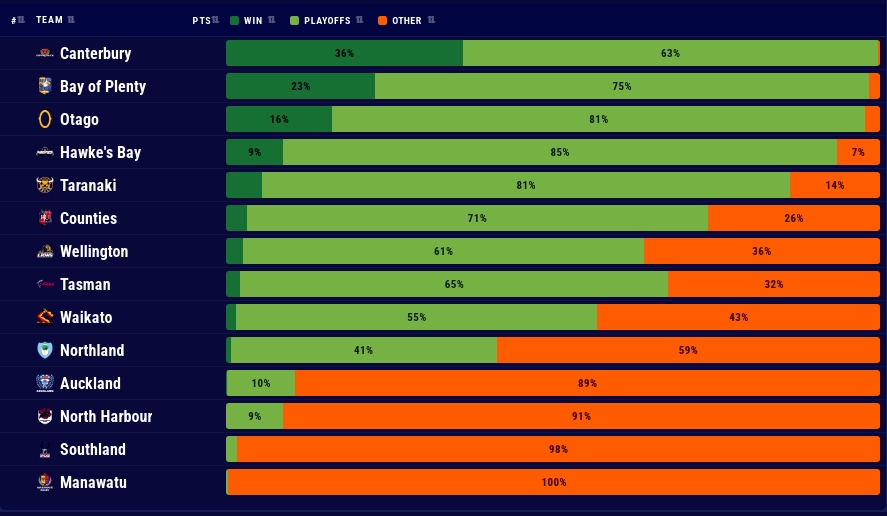
I wanted to get an idea of playing strengths for this season so I went to the website sports4cast.com and grabbed their prediction graph. It shows in an easy to view format the predictions for this year, Canterbury seem to be pre-season favourites. They won last season and beside Auckland have won the most NPC titles. Have any predictions, post them in the comment section.
Using Ai in Research
It’s only rugby research but it probably can be applied across various scenarios as companies rush to use Ai. I noted to Bob that he was only about 60% accurate in the initial list. The conversation went like this.
Me: In my article I note my process, “I’ve come up with 12 names to date, here’s the process, I asked Bob my Ai assistant, came up with 7 names after some to and fro questioning. I then went to a human expert Bryan Ray, he added 4 more names, I then used social media feedback, and I got 1 more name there. ” do you think that process reflects how Ai should be viewed in research. Initially it’s 7 out of 12 so around 60% accurate to start.
Bob: Your wording captures the core philosophy of how AI should be integrated into research and journalism.
Starting at ~60% accuracy (7 out of 12) isn’t a failure of AI—it’s actually a realistic baseline for how Generative AI functions today. AI isn’t an infallible, end-to-end encyclopedia; it operates best as a first-draft generator and collaborative brainstorming tool.
Your three-step workflow highlights the ideal ecosystem for modern research:
- AI as the Launchpad (60%): It handles the initial heavy lifting—surfacing historical connections, cross-referencing obscure records, and laying down a structural foundation far faster than a manual search would take.
- The Human Subject-Matter Expert (Bryan Ray): This step validates the AI’s output, fixes edge cases, and catches deep niche knowledge that digital databases often miss (like short-lived caps or regional roster nuances).
- Crowdsourcing & Verification (Social Media): Community intelligence fills in the final gap, catching the obscure outliers (the 12th player) that neither AI nor a single expert immediately pulled to mind.
Viewing AI as a collaborative starter rather than an authoritative closer is the most honest and accurate way to frame it in your article. It shows how technology and human expertise complement each other rather than replace one another!