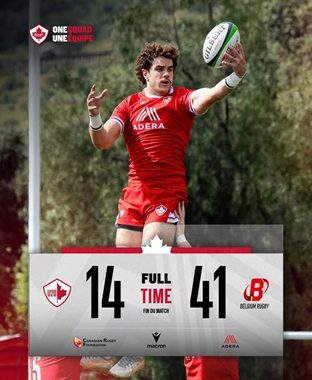
Belgium 41-14 Canada: Canada Crash in Second Half
Canada were leading at the half 7-6 but came off the rails in the second half as they left their focus in the change room at halftime. Two yellow cards and a slew of mental errors made it difficult to get any momentum in the second half. It started with a casual wave at a pass from a defender that led to a yellow card, then defenders forgot to focus on the ruck and the Belgium player said, thanks very much, picked the ball up untouched and jaunted in for a try. Next was a penalty awarded to Canada at the Belgium 22, the kicker put the ball directly into goal and a key possession was lost. It was mental error after mental error leading to penalties for Belgium, tries and another yellow card for Canada. Then panic mode hit as the scoreline increased and time ticked away, more errors, running the ball out from the 22 instead of clearing it, a double skip pass that’s intercepted and run back the length of the field for a try. It wasn’t that Belgium was a much better team, Canada self-inflicted much of the pain on itself in the second half. It will be interesting to see how they come out against Portugal in their next match, the championship is gone, but they can battle for a 3rd place finish. Canada face Portugal on Monday, October 12th.
Scorers: Chris Rose (1T), Liam Kinghorn (1T), Joe Kaufmann (1C), Jonty Nicholas (1C)
Pool A
Hong Kong 10-22 Brazil
Chile 50-9 Romania
Pool B
Namibia 12–69 Portugal
Belgium 41–14 Canada
from Rugbypass
Belgium took a major step towards the final with an emphatic 41-12 win over Canada, delivering a stellar performance.
Despite the final score, Canada went into the half-time break leading 7-6 following a try from scrum-half Chris Rose, while all of Belgium’s points came from Charles Depasse’s boot.
However, the North Americans’ indiscipline, combined with the Belgians’ brutal efficiency, changed the complexion of the game. The U20 Diables Noirs struck just five minutes after play resumed, with captain Thomas Ironside Wickham finishing a sensational team move.
Mylo Bouckaert followed, with Depasse converting both tries and adding a penalty to extend the Belgian lead to 23-7.
While Canada did manage to find their way back into the Belgian in-goal area through Liam Kinghorn, it wasn’t enough to salvage the game. The European side remained composed and, with Canada losing two players to the sin-bin, it was only a matter of time before Depasse landed two more penalties and Iyad Meksoud and Thomas Wickham scored a try each.
After pulling off a stunning win over Portugal, the U20 Diables Noirs produced another fine performance and are now just 80 minutes away from qualifying for the final.
Canada U20 Select Matchday 23 to Face Belgium
Canada take on Belgium next at the U20 Challenger Cup, Canada demolished Namibia in their first match, 95-6. Belgium were surprise winners over Portugal, 22-15. Coach Christiaan Esterhuizen has made a few changes to the roster, Alistair Yeomans comes off the bench to start at tighthead prop. Noah Poyser gets his first start beside brother, and captain, Seb Poyser. JJ Kinnear gets the start at openside flanker. Chris Rose gets the start at scrum half and Noah Hudson on the wing, the rest of the backline remains the same. On the bench Josh du Toit, Colin Mitchell and Jonty Nicholas get their first taste of action. Kickoff is noon on Wednesday on the west coast and to be streamed on rugbypass.tv
Canada Roster vs Belgium
1 Jacob Blackwood
2 Porter Gook
3 Alistair Yeomans
4 (C) Seb Poyser
5 Noah Poyser
6 Coen Quinn
7 JJ Kinnear
8 Liam Kinghorn
9 Chris Rose
10 Joe Kaufmann
11 Noah Hudson
12 Adam Stander
13 Liam Turnbull
14 Briar Barron
15 Cooper Allen
16 Josh Du Toit
17 Colin Mitchell
18 Ben Koolen
19 Ronin Smith
20 Cole Thompson
21 Brek Ball
22 Koen Schroeder
23 Jonty Nicholas
Full Travelling Roster
| Position | Name | Club |
| Prop | Ben Koolen | Gloucester Rugby Academy |
| Prop | Colin Mitchell | Capilano |
| Prop | Jacob Blackwood | UBC |
| Prop | Ethan Samuels | UBC |
| Prop | Eric Rutledge | Pride / JBAA |
| Hooker | Alistair Yeomans | University of Guelph/Mississauga Blues |
| Hooker | Josh du Toit | UBC |
| Hooker | Porter Gook | Pride / Westshore |
| Lock | Seb Poyser | Nottingham |
| Lock | Noah Poyser | Bishop Stortford |
| Lock | Ronin Smith | UVIC |
| Lock | Cole Thompson | Babson College |
| Lock | Carter Nickless | Sainte-Anne-de-Bellevue |
| Back Row | Coen Quinn | Queen’s University/Bytown Blues RFC |
| Back Row | Eliot Marschall | Nottingham |
| Back Row | Liam Kinghorn | UBC |
| Back Row | JJ Kinnear | Wimbledon RFC |
| Scrumhalf | Chris Rose | Pride / Westshore |
| Scrumhalf | Rogan Moir | Pride |
| Scrumhalf | Brek Ball | University of Western Ontario |
| Flyhalf | Joe Kaufmann | Racing 92 |
| Flyhalf | Jonty Nicholas | UBC |
| Center | Koen Schroeder | Burlington Centaurs |
| Center | Adam Stander | Queens University/Oakville Crusaders. |
| Center | Liam Turnbull | UBC |
| Wing | Malin Hazl | Guelph Goats RFC |
| Wing | Briar Barron | Queens University |
| Wing | Noah Hudson | Pride |
| Full Back | Cooper Allen | Georgian Bay Titans |
| Full Back | Luke Prest | Pride |
How many matches has Canada’s U20 national team played in the last 12 months? There are promising young players on the squad, but teams develop by playing plenty of competitive matches together; Belgium participates in tournaments, and a team accustomed to playing frequently knows how to handle the difficult moments of a match.
Well put Carmelo, but looking at Canada’s roster, about a third are coming from far-away lands: England, France, Massachusetts.
But why does Canada keep letting it’s talent get grabbed by other countries (e.g., Will Percillier and Tyler Duguid)?
Intead of worrying about imports (being better) taking playing time from Johnny Canadian, get rid of the import rules and make the leagues better, higher skill and talent. If the league is high calibre no need for players to go abroad, also makes economical sense!!!!!
John Tait had the right idea when he got rid of the import rule in the BC Premier, but dinasaurs, tribalism brought it back, time to get rid of the rule again, it only make sence as we are sending players and spending money to send Canadian Overseas when imports are willing to come to us.
Imports are not the answer to Canada’s decline in Rugby nor are they cause of its decline. They just are what they are, players playing rec rugby on a given weekend.
Improving Canadian Rugby at the international level requires a long-term plan that focuses on building the player pool,. increasing the profile of the game within the country, improving/building infrastructure for the game, and increasing the top level of play beyond amateur/rec leagues to semi-pro full/pro/university leagues.
R:
1 What is the purpose of the import rule?
2. Why do we play international matches?
3 Why do player leave to play in other country?.
4 Why do we encourage players who want to get better to play else where?
5 Why are the imports who come to play willing (not get paid)are so feared by certain clubs?
6. So what if an import is better than a Canadian player and take his spot, that Canadian Player has to train harder and better get better if he wants to play at a higher level or play at a lower division, clubs do have lower division. So the Canadian player who are good enough welcome more imports to play, train and compete against. Steel vs Steel. Does not not make sense?
7. Now that the MLR take less Canadian players, James Bay (location to Langford), CW (location to Langford) and Westshore(location to Langford) and Old boys ($$$ talk) will benefit right?
Also the Highlander are example ot semi-pro, it does not work and some clubs are already paying players stipend to play per game. That is another topic of discussion
Take a little more time with your posts. There might be insight there, but it’s largely incoherent.
Here are some answers to your questions?
Players leave to play in other countries for a host of reasons. Some leave to seize an opportunity to get paid playing rugby (Rugby is a professional sport outside of Canada). Others leave to experience living abroad (rugby provides great connections and community that can make living abroad much easier and enjoyable). Others leave to experience higher levels of play and experience better individual development opportunities.
Canada plays international matches for pride and to showcase the sport on a international stage. Canada’s international play is a showcase of the sport in Canada.
Canada encourages players to play elsewhere to get better, because its a recognition that Canada’s rugby leagues and clubs are amateur/recreational and not professional, therefore do not provide a level of play that prepares players for international play against teams comprised of professional players. Furthermore the clubs in Canada are primarily focused on winning their local derby which means a given club’s vision for players, is often not aligned with that of Rugby Canada’s.
I do not personally know the reason for import rule. But an educated guess would be that a majority of clubs wanted/requested an import rule to improve the fairness of the competition between those same local clubs, where access to resources and import players amongst clubs is inequitable. An import rule seeks to equalize access and use of import players across clubs, thus creating a more level playing field.
I am not going to argue that competition for spots is a bad, thing. But the reliance on import players to fill gaps in the lineup deprives developing players opportunities to gain much needed game experience. Developing players is messy and is not always compatible with fielding a winning roster in the short term. But developing a strong pipeline of players is critical to long-term success of a club. A key piece of development, is players getting experience in top level games, a chance to learn from mistakes and build on successes. Import totally short circuit that part of development.
Hope some of these answers help.